

Elder Associates Limited (EAL) is a private and confidential service organization that provides Employee Assistance Programmes (EAPs) as well as a full spectrum of psychological services to individuals, families, and organizations.
Founded in 1993 by the late Dr. Patricia L. Elder – former Counselling Psychologist and Certified Employee Assistance Professional – Elder Associates Limited was established to enhance the professional delivery of psychological services in a culturally diverse environment.
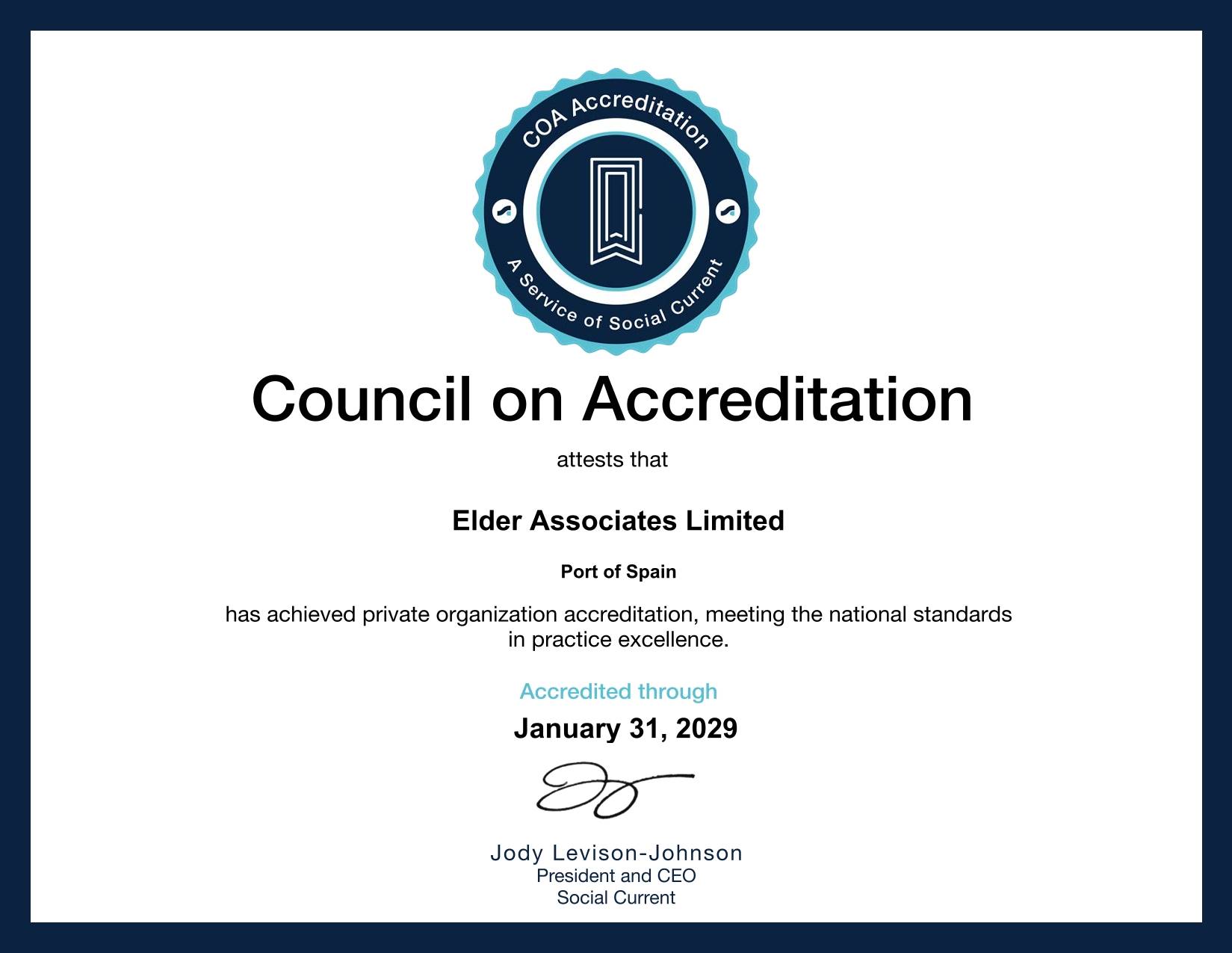
We are recognized locally, regionally, and internationally for our competency in the design and implementation of EAPs. Since 2013 The Council on Accreditation (COA) accredited EAL as an EAP service provider in The Republic of Trinidad and Tobago. We have been reaccredited every four years ever since, with the latest reaccreditation granted in January 2025 through to 2029.
Mission Statement
To provide accessible, prompt, and responsive EAP and other psychological services to all our clients.
Vision Statement
To be the leading provider of EAP and other psychological services in the greater Caribbean region.
Core Values
Confidentiality – To protect the clients’ rights to privacy and counsel.
Ethical Standards – We adhere to the Code of Ethics of EAPA which defines professional conduct in all activities.
Love – We are committed to serve in a non-judgemental, caring, respectful, and compassionate manner.
Professionalism – Consistent delivery of expert services.
Integrity – Uncompromising honesty and reliability in everything we do.
Team Oriented – Working together to achieve the organization’s goals.
Find out more about our founder
Dr. Patricia Elder, Founder/Director, Elder Associates Limited.
The late Dr. Patricia L. Elder, Founder and former Chair, Elder Associates Limited
She was a leader and visionary for the delivery of mental health services in the Republic of Trinidad and Tobago. Dr. Elder attained her Doctorate in Counselling Psychology at Temple University, U.S.A.
Founded in 1993, Elder Associates Limited, provides Employee Assistance Programmes (EAPs) and other psychological services to individuals and organisations. In 2013 …
Dr. Elder was also the Caribbean Regional Director, Institute for Forensic Psychology, having provided employment evaluations of law enforcement recruits. Her publications included: “EAP and Public Service Reform”, ‘The Expanding Role of EAPs” in Dr. Dale Masi, “International Employee Assistance Anthology.” 1st and 2nd edition.
Dr. Elder was the Founder/Director of the Dr. J.D. Elder Collection Foundation, preserving the works of her father, Dr. J.D. Elder, a recognized national icon of Caribbean culture.

The Benefits of Organizational Accreditation
It is no secret that the Council on Accreditation (COA) believes in what we do. We promote best practices and help our organizations to implement them with the aim that clients across the various sectors of the country will get the best possible quality of care. By accrediting the entire organization, we ensure that everyone – from clinicians to administration and support staff – is working together to carry out that mission.
“Improving service quality is the most important benefit of organizational accreditation.”
Organizational accreditation holds the team to its goals.
As anyone with a broken New Year’s resolution knows, it is easy to put great plans in place and never carry them out. Accreditation (and reaccreditation!) forces organizations to follow through with those great plans, holding them accountable to be the best they can be. Ninety-four percent (94%) of COA- accredited organizations agree that our whole-organization accreditation improves transparency and accountability. Through it, staff become not only accountable to their clients and stakeholders, but to themselves.
Organizational accreditation can give staff a sense of fulfilment.
Accreditation encourages organizations to look at themselves frankly and work toward continuous quality improvement. This can allow staff to take a break from their daily grind and appreciate the big picture of their impact. Organizational accreditation also facilitates transparency and open communication, which can increase trust and the feeling that everyone is working as part of one team. Finally, the quest for quality improvement provides staff with new professional opportunities, allowing them to lead the charge toward a brighter future for those they serve.